
Robert DeLaurentis: The Peace Pilot Who Circumnavigated Between the South and North Poles.
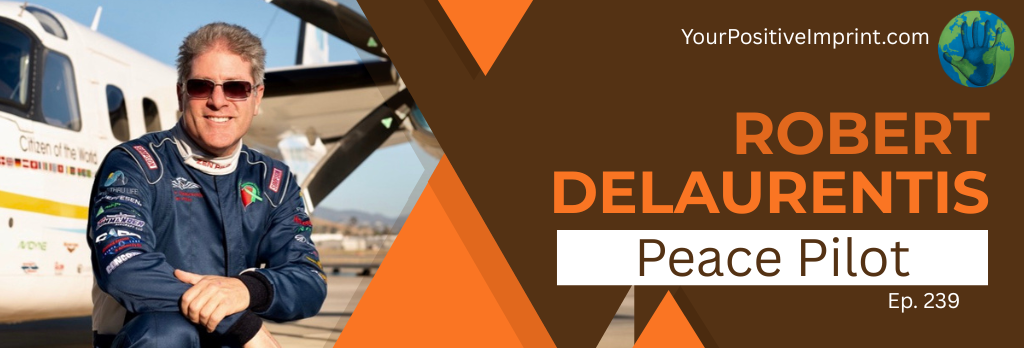
Meet Robert DeLaurentis, the Peace Pilot—retired Navy Lieutenant Commander, author, inductee into the Legends of Flight Hall and Fame, and entrepreneur. He flew solo from the South Pole to the North Pole in a biofuel-powered twin-engine plane collecting data for research with the Scripps Institution of Oceanography and NASA. His mission sought to inspire change and confront fear while fostering a harmonious relationship with nature.
Transcript
it is April 26th and we tip our hats skyward for World
Catherine:Pilot's Day, celebrating the skill and dedication of aviators globally.
Catherine:This dedication day was established to commemorate the inaugural flight
Catherine:of the first Turkish pilot in:Catherine:Well, it is an honor to celebrate pilots worldwide, especially my
Catherine:guest today, Robert DeLaurentis.
Robert DeLaurentis:It was like living in a fuel tank so your eyes would burn,
Robert DeLaurentis:your sinuses would burn, and when you would swallow, you could taste the fuel.
Rick Huff:your positive, positive, positive imprint, imprint, imprint,
Rick Huff:imprint stories are everywhere.
Rick Huff:People and their positive actions inspire positive achievements.
Rick Huff:Your PI could mean the world to you.
Rick Huff:Get ready for your positive imprint.
Catherine:Hello there.
Catherine:I'm Catherine, your host of this Variety show podcast.
Catherine:Your positive imprint is transforming how we live today
Catherine:for a more sustainable tomorrow through education and information.
Catherine:Your own positive actions inspire, change.
Catherine:Follow me on Instagram and my YouTube channel, your Positive Imprint, and
Catherine:you can also follow me on Facebook and connect with me on LinkedIn.
Catherine:Check out my website, yourpositiveimprint.com, where you
Catherine:can learn more about the podcast and sign up for email updates.
Catherine:Thank you so much for listening.
Catherine:Music by the legendary and talented, Chris Nole.
Catherine:ChrisNole.com C-H-R-I-S-N-O-L-E.
Catherine:Thank you again for listening and for your support of this
Catherine:podcast, your positive imprint.
Catherine:What's your pi?
Catherine:Wow.
Catherine:Oh my gosh.
Catherine:Today's guest is already a legend, a legacy filled with brilliant
Catherine:and inspiring positive imprints.
Catherine:Setting records certainly draws attention.
Catherine:So who is this remarkable figure?
Catherine:Robert DeLaurentis is an author, entrepreneur, exceptional pilot,
Catherine:and a retired veteran lieutenant commander in the United States Navy.
Catherine:As the solo pilot, he flew from the South Pole to the North Pole and everywhere
Catherine:in between navigating his twin engine propeller plane, powered by biofuels,
Catherine:which I am really excited about.
Catherine:And during his journey as peace pilot, he also gathered data for research in
Catherine:collaboration with Scripps Institution of Oceanography and also nasa.
Catherine:He embarked on this adventure as a global citizen on a mission to inspire,
Catherine:change and leave even more positive imprints while facing what he calls
Catherine:his greatest challenge of all fear.
Catherine:While maneuvering through the notorious Drake passage, his peace
Catherine:mission extends beyond just humanity.
Catherine:It encompasses harmony with
Catherine:all of nature.
Catherine:Well, Robert is indeed a legend having been inducted into the legends of
Catherine:Flight Hall of Fame at the Air and Space Museum in San Diego, and I am
Catherine:thrilled, , I am honored to welcome.
Catherine:Robert DeLaurentis here to the show.
Catherine:Robert, welcome.
Robert DeLaurentis:Thank you, Catherine.
Robert DeLaurentis:You did that quite well.
Robert DeLaurentis:Sometimes I hear these introductions and I go, wow, who is that crazy
Robert DeLaurentis:person they're talking about?
Robert DeLaurentis:And it just happens to be me, I guess.
Catherine:It is.
Catherine:And I, I have loved researching you and the introduction could
Catherine:have been an hour or two hours.
Catherine:You just have so many positive imprints and I'm excited and I'm just
Catherine:so thrilled to have finally met you.
Catherine:Thank you again.
Robert DeLaurentis:We're, uh, we're really happy with the
Robert DeLaurentis:we started the foundation in:Robert DeLaurentis:I reflect back and there's a lot in the world and.
Robert DeLaurentis:It, uh, all connects together almost perfectly with the completion of the
Robert DeLaurentis:movie, , DeLaurentis International Airport, and eventually, uh, in the next
Robert DeLaurentis:year putting the citizen on of the world on display in front of the airport.
Robert DeLaurentis:So,
Catherine:oh,
Robert DeLaurentis:very happy.
Robert DeLaurentis:So,
Catherine:okay, so listeners, what Robert is talking about, about, he
Catherine:owns a airport in Oak Grove, is it
Robert DeLaurentis:Oak Harbor, Washington on Woodby Island, just off
Robert DeLaurentis:the coast of Seattle, south of Canada.
Catherine:Yeah.
Catherine:And it, it's a, a nice quaint airport and you can certainly find that online
Catherine:to learn more about the airport, , so you're going to have the plane.
Catherine:And my goodness, you had this feat back in 20 19, 20 20 of flying.
Catherine:But yet, when I was reading about you, you were not even a pilot in the Navy.
Robert DeLaurentis:Yeah.
Robert DeLaurentis:You got it right.
Robert DeLaurentis:I, um, was not a pilot in the Navy.
Robert DeLaurentis:I didn't have the vision that they required, the eyesight and, um,
Robert DeLaurentis:but the desire to fly continued.
Robert DeLaurentis:And funny thing about flying Catherine is you can't really do it unless you have
Robert DeLaurentis:the time and the money at the same time.
Robert DeLaurentis:And for me, that was kind of elusive.
Robert DeLaurentis:And when I retired, for the second time, actually at age 43, those things
Robert DeLaurentis:finally came together and I decided to focus my energies on flying.
Robert DeLaurentis:Uh, a few years later I was doing my first equatorial circumnavigation, , in
Robert DeLaurentis:a plane called the Citizen of the World.
Robert DeLaurentis:So flying around the world along the equator.
Robert DeLaurentis:And, uh, then in:Robert DeLaurentis:doing a polar circumnavigation over the north and south poles and a much
Robert DeLaurentis:more, uh, capable and complex plane called the "Citizen of the World",
Robert DeLaurentis:which is what the movie's about in part.
Catherine:Yeah.
Catherine:Which we will get to.
Catherine:And by the way, thank you for your service in the United States Navy.
Catherine:We all appreciate, , our service personnel, so thank you for that.
Catherine:And so growing up, you grew up in the United States,
Robert DeLaurentis:uh, for a time, yeah.
Robert DeLaurentis:I spent two and a half years in Jakarta, Indonesia.
Robert DeLaurentis:Uh, with my family.
Robert DeLaurentis:I went to a joint embassy school over there, and it was sort of
Robert DeLaurentis:my first exposure to, , life beyond the United States.
Robert DeLaurentis:I, I loved, uh, airplanes since the very beginning, and I remember my dad and I, we
Robert DeLaurentis:went to the school that I was attending.
Robert DeLaurentis:It was called, uh, JES, the Joint Embassy School, and we put together a couple,
Robert DeLaurentis:uh, picnic tables and attempted to launch one of my, uh, strength controlled
Robert DeLaurentis:gas planes and, uh, , bounced from one table to the next, to the next and
Robert DeLaurentis:then into the ground and was destroyed.
Robert DeLaurentis:So the first first attempt at, uh, flying wasn't necessarily
Robert DeLaurentis:successful, but it was exciting and, , told me there was more to come.
Robert DeLaurentis:But, , living overseas, uh, really opens you up to the rest of the world
Robert DeLaurentis:and that there are other people.
Robert DeLaurentis:And uh, maybe that was my first exposure to the fact that, uh, people are
Robert DeLaurentis:more similar than different, right?
Robert DeLaurentis:They, they focus on their families and their health and
Robert DeLaurentis:their safety, , their joy, their happiness, their financial security.
Robert DeLaurentis:And then all those other things are sort of secondary.
Robert DeLaurentis:So, uh, yeah, we, you made international friends and saw the world was a big place,
Robert DeLaurentis:you know, not without its challenges.
Robert DeLaurentis:So it was a defining moment in my life for sure.
Catherine:Well, and, and having those experiences, like you say overseas
Catherine:and meeting people and seeing how they live and seeing their values
Catherine:that shape them as a culture is truly that, is, that defines them.
Catherine:It may not define you, but it's, you take that with you, , some of that.
Robert DeLaurentis:Absolutely.
Robert DeLaurentis:, I, I think getting out from behind our computers and going into the world, kinda
Robert DeLaurentis:like you just did recently in Europe, , is the best way to learn about the world.
Robert DeLaurentis:'cause you get to meet these people in person.
Robert DeLaurentis:You get to, , watch their expressions when they're talking to you
Robert DeLaurentis:and learn about their passions.
Robert DeLaurentis:It's really, , I think something that everybody should have to
Robert DeLaurentis:do at some point in their life.
Catherine:Yeah.
Catherine:So citizens of the world.
Catherine:So, uh, I love that.
Catherine:And in:Catherine:phrases, we are all citizens of the world trying and hopefully doing our part.
Catherine:And you took your plane and, and you as a citizen of the world wanted
Catherine:to bring hope and peace to citizens of the world, which is everybody.
Catherine:And you met so many people on this.
Catherine:So let's talk about, the flight and the research and the foundation.
Catherine:I mean, there's a lot to cover in in this, so why Citizens of the World?
Catherine:Why did you want that on your plane?
Robert DeLaurentis:Yeah, the way we came up with that is, , my first book,
Robert DeLaurentis:um, and Trip, I was the Zen pilot.
Robert DeLaurentis:And then on the second one, um, I was the peace pilot.
Robert DeLaurentis:It was sort of an evolution, but CitiZen, um, of the world seemed to make sense.
Robert DeLaurentis:And the funny thing, Catherine, is I didn't see that connection until about
Robert DeLaurentis:a year after we had named the plane.
Robert DeLaurentis:Citizen of the world.
Robert DeLaurentis:And um, I was on a qua wall and , uh, I believe it was Spain and they had
Robert DeLaurentis:a picture and there was, uh, a person with one side of their face was
Robert DeLaurentis:dark and the other side was light.
Robert DeLaurentis:And it sort of spoke to me.
Robert DeLaurentis:It was talking about the connection between people and that's in the movie.
Robert DeLaurentis:You get to see that.
Robert DeLaurentis:So yeah, it just seemed like a more ambitious project.
Robert DeLaurentis:And when I was doing my spiritual psychology studies, I remember talking
Robert DeLaurentis:to my instructor, a guy named Ron Nik about what the mission should be.
Robert DeLaurentis:I didn't want it just to appear to be a guy flying around the
Robert DeLaurentis:world, having a good old time.
Robert DeLaurentis:, We had to have the science, we wanted to have the message for people and we
Robert DeLaurentis:wanted to have some positive impact.
Robert DeLaurentis:And he suggested global peace.
Robert DeLaurentis:And at the time I laughed, I thought way too big for me.
Robert DeLaurentis:And I think we were laughing for different reasons.
Robert DeLaurentis:Laughed 'cause it was kind of an awkward moment.
Robert DeLaurentis:And I was laughing 'cause I didn't think I was capable of that.
Robert DeLaurentis:But, I was intent on having a positive impact on the world.
Robert DeLaurentis:And that seemed to be the way I could do it by bringing together my passions, which
Robert DeLaurentis:were business, spirituality and flying
Catherine:and the spirituality part.
Catherine:Zen.
Catherine:I never, ever, until you said that the zen, that that never ever crossed my mind.
Catherine:And you have the, you have the book Zen Pilot, which talks about the
Catherine:spirituality and then you also have peace pilot, which talks more about,
Catherine:um, not so much the spiritual part, but the documenting of the, the
Catherine:trip and the meeting of the people.
Catherine:And then there's a movie as well with the same name.
Robert DeLaurentis:I would say, Catherine, that all these things,
Robert DeLaurentis:including the three children's books and the Flying through life are really
Robert DeLaurentis:deeply, deeply spiritual projects.
Robert DeLaurentis:And we tried to go about it in a way so we wouldn't spook anybody, right?
Robert DeLaurentis:We want it to be very subtle and peace pilot meeting the people,
Robert DeLaurentis:but it's about connecting the north and south poles and everybody in
Robert DeLaurentis:between and this concept of oneness.
Robert DeLaurentis:And we used to say one planet, one people, one plane.
Robert DeLaurentis:So yes, , it is about the journey, it is about the science.
Robert DeLaurentis:Um, to me it's all about the spiritual side of life and you
Robert DeLaurentis:know how we connect with that, how we connect with other people.
Catherine:And that connection is one of the most important parts of life.
Catherine:And you met an enormous number of positive imprints on your travels
Catherine:so let's go to the science part.
Robert DeLaurentis:Sure.
Robert DeLaurentis:It was a turbine commander 900.
Robert DeLaurentis:We had modified it in over 50 ways, , including predator B drone
Robert DeLaurentis:engines, which were the most efficient engines even at the military uses.
Robert DeLaurentis:, And we pushed the range of the plane from six hours out beyond 18.
Robert DeLaurentis:And it's one thing to double the range of a plane, but to go beyond triple
Robert DeLaurentis:is, , a story in a, in and of itself.
Robert DeLaurentis:But, , the plane was really a vehicle for our message.
Robert DeLaurentis:And like I said, connecting the north and south Poles, the two
Robert DeLaurentis:places where pieces always existed.
Robert DeLaurentis:And, , of course we were filming and our goal was legacy.
Robert DeLaurentis:, It's a big part of the foundation and I believe, , people get to a point
Robert DeLaurentis:in life where, , they've met their basic needs for example, they're maybe
Robert DeLaurentis:retired and now there's this extra time or this extra responsibility
Robert DeLaurentis:that they have to the world, I think.
Robert DeLaurentis:'cause you're not just here for the ride, right.
Robert DeLaurentis:, We like to think that we are giving back and making it a better place.
Catherine:Mm-hmm.
Robert DeLaurentis:Again, having a positive impact on the world.
Catherine:Maybe that's another book in itself is the building of the plane.
Robert DeLaurentis:Certainly for the pilots,, or people that are
Robert DeLaurentis:really interested in aviation.
Robert DeLaurentis:It's a pretty fascinating, uh, story about taking yourself and
Robert DeLaurentis:your aircraft, , beyond its limits.
Catherine:Mm-hmm.
Catherine:. Okay.
Catherine:So.
Catherine:, You were working collaboratively with NASA and Scripps, so what was the
Catherine:research and the data that you were trying to collect and what is it showing?
Robert DeLaurentis:Well, it's interesting, , you bring that up because
Robert DeLaurentis:there's a guy named Dr. Dmitri de Haine and I was at a celebration of life
Robert DeLaurentis:ceremony for a guy named Walter Monk, who is considered the Einstein of the oceans.
Robert DeLaurentis:He was over a hundred years old.
Robert DeLaurentis:And Dmitri, one of his scientists, got up and said that
Robert DeLaurentis:he was a citizen of the world.
Robert DeLaurentis:And I was looking for an experiment at the time.
Robert DeLaurentis:And Dmitri's experiment was to collect plastic particles in the,
Robert DeLaurentis:uh, atmosphere to try and explain how plastic has gotten into, well,
Robert DeLaurentis:specifically microfibers have gotten into every body of water on the planet.
Robert DeLaurentis:And he was trying to show that they were, uh, in the air.
Robert DeLaurentis:And surprisingly in my, , research, , and collection of data with the plane, uh,
Robert DeLaurentis:we found there was more plastic in the air over the poles than there was over
Robert DeLaurentis:the equator where the population was.
Robert DeLaurentis:So it's really pretty groundbreaking.
Robert DeLaurentis:, They've discovered plastics in the, uh, uh, water, these plastic islands,
Robert DeLaurentis:but there's actually plastic in the air, and that's more important for us
Robert DeLaurentis:as humans because we're inhaling it.
Catherine:Mm-hmm.
Robert DeLaurentis:Right.
Robert DeLaurentis:And everything we wear, like this shirt I have on now has got some microfibers.
Robert DeLaurentis:It doesn't wrinkle right.
Robert DeLaurentis:It looks nice.
Robert DeLaurentis:It's shiny.
Robert DeLaurentis:We like to wear it.
Robert DeLaurentis:But, um, I'm also putting down a trail of, uh, microplastics all over the place.
Robert DeLaurentis:That's what we found.
Robert DeLaurentis:And, um, groundbreaking stuff.
Robert DeLaurentis:I think at some point that'll work its way into a Nobel Prize for this guy
Robert DeLaurentis:because it's so important for humanity.
Robert DeLaurentis:, The NASA wafer scale spaceship that I carried, uh, was very important.
Robert DeLaurentis:It was the first time it made it outside the lab.
Robert DeLaurentis:, It was a uc, SB uc, Santa Barbara funded experiment paid for by nasa,
Robert DeLaurentis:and it's the future of space travel.
Robert DeLaurentis:So we see, let's say Elon Musk sending his rockets up with some astronauts.
Robert DeLaurentis:, That's really not the future, , because it's expensive to push
Robert DeLaurentis:a huge rocket, the motor, the fuel, the astronauts in the space.
Robert DeLaurentis:Instead, what they're doing is they're taking these little, , wafer
Robert DeLaurentis:scale, . They look like circuit boards and they're blasting 'em out
Robert DeLaurentis:into space using electromagnetic cannons and then using lasers to
Robert DeLaurentis:push 'em either even further out.
Robert DeLaurentis:And the support for that is on, it's all ground based, so you're not pushing
Robert DeLaurentis:something heavy into space, and they can launch those every 15 minutes.
Robert DeLaurentis:So it's really the, the future of space travel.
Robert DeLaurentis:I carried it with me and it took, , over 30,000 pictures.
Robert DeLaurentis:It measured temperature, speed, altitude, location, and it's actually in our museum
Robert DeLaurentis:at, , DeLaurentis International Airport
Catherine:Airport.
Catherine:Oh, awesome.
Catherine:So now NASA obviously is using that data to better their research.
Catherine:I read about what Scripps was doing, with the research, the microplastics now
Catherine:it's in the air, we have to do something.
Catherine:And I think that we can do better and make some changes
Robert DeLaurentis:There's hope, right?
Robert DeLaurentis:Learning about this is maybe the first step in it all.
Robert DeLaurentis:, We also, or I also carried, when I say we, it's myself and the citizen
Robert DeLaurentis:of the world, but uh, also carried the biofuels like you had mentioned.
Robert DeLaurentis:Mm-hmm.
Robert DeLaurentis:First time using those over the north and south poles.
Robert DeLaurentis:And then, uh, special type of tracking system, which tracked me.
Robert DeLaurentis:All the way around the planet within like 30 feet.
Robert DeLaurentis:And we have all that data that was used as well.
Robert DeLaurentis:So , the trip was really pretty rich in terms of science and that was important
Robert DeLaurentis:so that it wasn't just about promoting aviation, technology and safety, but it
Robert DeLaurentis:was, , how does this benefit the planet?
Catherine:So let's talk about the biofuels.
Catherine:Those were plants, animal waste, algae material,
Robert DeLaurentis:yes,
Robert DeLaurentis:yeah, it's not a hundred percent biofuels.
Robert DeLaurentis:Nobody has a hundred percent.
Robert DeLaurentis:But, um, those were provided, to us by Gulfstream.
Robert DeLaurentis:And then when I got over to Europe, they're actually using that already.
Robert DeLaurentis:So they're steps ahead of us, but we were really happy to help, you know,
Robert DeLaurentis:draw a little bit of attention to that.
Robert DeLaurentis:And there was actually a benefit.
Robert DeLaurentis:The, the jet fuel made from biofuels doesn't gel at, , a certain temperature.
Robert DeLaurentis:You can actually get it a little bit colder.
Robert DeLaurentis:And since I was flying over, uh, a cold region of the plaintiffs and
Robert DeLaurentis:minus 60 Celsius, any help we could get was, , greatly appreciated.
Catherine:I'm glad to hear you say that there are places in the world that
Catherine:are already using the biofuel, such as Sweden, and they had it available for you.
Catherine:Because you lost, , one of the tanks.
Robert DeLaurentis:That was over the South Pole.
Robert DeLaurentis:I had to draw from all the tanks.
Robert DeLaurentis:I had planned to save some of that fuel for later, but there
Robert DeLaurentis:was this issue of survival.
Robert DeLaurentis:, So I had to burn it, get back over the Drake passage, actually.
Catherine:Well, and you mentioned your fear factor.
Catherine:, We all have fears , I was glad that you were honest about how you were feeling
Robert DeLaurentis:Yeah.
Robert DeLaurentis:On my first trip in the book, uh, Zen Pilot, I talk about fear
Robert DeLaurentis:being my constant companion.
Robert DeLaurentis:And I actually used fear, to tip me off to the issues that I would have.
Robert DeLaurentis:Like for example, on that first trip, , I was waking up with panic
Robert DeLaurentis:attacks, not because what other people had told me was their concern.
Robert DeLaurentis:Like my dad said, you're gonna die.
Robert DeLaurentis:, A gal I was dating at the time said, you're gonna, , have
Robert DeLaurentis:to ditch in the Pacific Ocean and, , suffer and die by yourself.
Robert DeLaurentis:That that wasn't my concern.
Robert DeLaurentis:My concern was, , landing at a remote airport in the middle of the night
Robert DeLaurentis:with weather on an island, , with mountains, and that just terrified me.
Robert DeLaurentis:So what I would do is I would go up at night, , I went over to, , the Truckee
Robert DeLaurentis:airport near Lake Tahoe where they have water and mountains and terrible
Robert DeLaurentis:weather, and it's a non towered airport.
Robert DeLaurentis:And I would do practice approaches at night in the absolute worst conditions.
Robert DeLaurentis:And I finally got quite proficient at it and I thought, well, maybe this is it.
Robert DeLaurentis:Maybe I don't have to deal with this anymore.
Robert DeLaurentis:But, , going into American Samoa, I was certainly tested and, , experienced
Robert DeLaurentis:those conditions, , in the darkest place I think I've ever been.
Robert DeLaurentis:I remember looking out the window and just seeing total black, and then I closed
Robert DeLaurentis:my eyes and there was no difference.
Robert DeLaurentis:Right.
Robert DeLaurentis:By yourself, right?
Robert DeLaurentis:I could have been on the sofa watching Netflix with, , a friend
Robert DeLaurentis:of mine back in the United States.
Robert DeLaurentis:So.
Robert DeLaurentis:It's, it's kind of interesting to pull yourself outta your comfort zone and,
Robert DeLaurentis:uh, deal with those fears directly.
Robert DeLaurentis:At DeLaurentis Airport, we have a plaque and it's a quote, , from Peace Pilot
Robert DeLaurentis:and it says, if you're not afraid, maybe your dreams aren't big enough.
Catherine:So we have to take some risks out there.
Catherine:Robert DeLaurentis: Absolutely, absolutely.
Catherine:You said that you were solo, but you also took your mom with you,
Catherine:, her ashes, some of her ashes, and that that was a, certainly a comfort for you.
Catherine:For sure.
Catherine:. And, and the spiritual, inner spiritual part.
Catherine:And I think that, that, that was another important part for you in this legacy.
Robert DeLaurentis:It was certainly a very emotional, moment for me.
Robert DeLaurentis:And, um, what I did is I took crashes with me and I had them and a little, , vial,
Robert DeLaurentis:glass vial, and it was in my backpack.
Robert DeLaurentis:And the night before I set out for the South Pole on that 18.1
Robert DeLaurentis:hour flight, I reached into the backpack and , I pulled my hand out
Robert DeLaurentis:and there were ashes on my hand.
Robert DeLaurentis:And it was, , it freaked me out.
Robert DeLaurentis:I was like, oh my God.
Robert DeLaurentis:It's like she's reaching out to me, touching me, comforting me in this
Robert DeLaurentis:time of need like a mother would.
Robert DeLaurentis:, I had been carrying that vial for months and months.
Robert DeLaurentis:And on that night, at that moment, , I had the experience,
Robert DeLaurentis:so, , she was definitely with me.
Robert DeLaurentis:We did, , this is gonna make me sound even crazier.
Robert DeLaurentis:We did use some psychics and, what they would always say is that your
Robert DeLaurentis:mom's looking out for you on this trip.
Catherine:In the film it was, it was emotional, I think for anybody
Catherine:watching it, , knowing that this occurred and you said in the movie,
Catherine:peace Pilot, this isn't fun anymore.
Catherine:I'm scared.
Robert DeLaurentis:You know, it's funny because , you have your
Robert DeLaurentis:supporters, you have your doubters, and then you have, , the rest.
Robert DeLaurentis:Some people call 'em the haters.
Robert DeLaurentis:And I had one friend of mine who said I was on a, sponsor funded vacation.
Robert DeLaurentis:And it was so far from the truth because I mean, I was suffering on
Robert DeLaurentis:a daily basis when the fuel tanks.
Robert DeLaurentis:A burst inside the plane and the jet fuel, , sprayed on my eyes, my face, my
Robert DeLaurentis:shoulders, groin legs, , and jet fuel is not a pleasant experience, highly toxic.
Robert DeLaurentis:, And my skin was burnt, , and we couldn't get the fuel out of the plane.
Robert DeLaurentis:It was, , beneath the floorboards.
Robert DeLaurentis:I ended up flying the remainder of the trip with, uh, close to probably a hundred
Robert DeLaurentis:gallons of jet fuel in the floorboards.
Robert DeLaurentis:And it was like living in a fuel tank so your eyes would burn, your
Robert DeLaurentis:sinuses would burn, and when you would swallow, you could taste the fuel.
Robert DeLaurentis:And I really didn't understand, , why I needed to be suffering so badly.
Robert DeLaurentis:But, , I eventually figured it out with the help of one of my friends.
Robert DeLaurentis:And it's that all living things suffer.
Robert DeLaurentis:I mean, you can.
Robert DeLaurentis:Walk in the park here at Balbo Park and you see animals that are,
Robert DeLaurentis:, injured, maybe a bird with like a, a bad leg or some plants are, , got
Robert DeLaurentis:a, some sort of fungus on them.
Robert DeLaurentis:I mean, there's homeless people.
Robert DeLaurentis:We're all in this constant state of suffering.
Robert DeLaurentis:And that's very much a Buddhist concept, but, um, true.
Robert DeLaurentis:And what I was trying to figure out and still haven't figured out
Robert DeLaurentis:is, , what was I being prepared for?
Robert DeLaurentis:Like, is there something in the future that I'm gonna be called to
Robert DeLaurentis:do just like I was on this mission?
Robert DeLaurentis:, Or is it just so that I could connect with humanity?
Robert DeLaurentis:'cause I don't know anybody who's just got the free ride, right?
Robert DeLaurentis:There's always challenges.
Robert DeLaurentis:, Catherine: I didn't see a vacation in there.
Robert DeLaurentis:Yeah.
Catherine:Uh, 18 hours alone sitting on the plane, being the one that's in charge.
Catherine:And it's not a computerized plane, it's you have the gadgets,
Catherine:although you had your iPad.
Catherine:I found that interesting that the iPad, you could actually get some information
Catherine:that you were losing from the controls on the airplane itself because of
Catherine:the magnetic anomalies that were occurring in the north and south poles.
Catherine:So that was incredible for me.
Catherine:But blood clots, what did you do for blood clots?
Catherine:You can't exactly stand up in that plane and walk around.
Robert DeLaurentis:Yeah.
Robert DeLaurentis:I had, uh, compression socks.
Robert DeLaurentis:Mm-hmm.
Robert DeLaurentis:Uh, which helped with that.
Robert DeLaurentis:And I was trying to, , do some exercises in my, , seat.
Robert DeLaurentis:Uh, , part of the trip is preparing for it.
Robert DeLaurentis:Mm-hmm.
Robert DeLaurentis:So like, for example, my eyes, I had, surgery.
Robert DeLaurentis:, Done on my eyes so that if I lost my glasses, , I wouldn't be blinded
Robert DeLaurentis:and I'd still be able to, , land the plane there was working out,
Robert DeLaurentis:becoming more of an athlete, right?
Robert DeLaurentis:And eating well.
Robert DeLaurentis:It's, it's a full body experience.
Robert DeLaurentis:It's not like the, the guy that just hops in the plane and goes for a spin.
Robert DeLaurentis:I had been preparing for that trip for 18 months and the, the first trip along
Robert DeLaurentis:the equator took six months to prepare for, and I had expected another six
Robert DeLaurentis:because the trip was three times harder.
Robert DeLaurentis:, That, , I was, uh, more experienced, had more sponsors, had better support,
Robert DeLaurentis:but it turned out to take 18 months to prepare for the polar trip just
Robert DeLaurentis:because of the complexity of it.
Robert DeLaurentis:So, , I was under extreme stress.
Robert DeLaurentis:I was waking up, having panic attacks.
Robert DeLaurentis:I had some internal bleeding.
Robert DeLaurentis:My hair was falling out.
Robert DeLaurentis:I mean, it's one thing to make promises to people, but then when
Robert DeLaurentis:you actually have to deliver.
Robert DeLaurentis:And it starts getting close.
Robert DeLaurentis:It gets real.
Robert DeLaurentis:It gets real.
Robert DeLaurentis:And at one point, you know, during one of these panic attacks, I was up in
Robert DeLaurentis:the middle of the night journaling.
Robert DeLaurentis:One hand was me, the other hand was, , God responding hopefully.
Robert DeLaurentis:And I said, , I need help.
Robert DeLaurentis:I can't do this alone.
Robert DeLaurentis:And the message I got back was, I'm sending angels.
Robert DeLaurentis:And it was funny 'cause the next day I had an event over at the Gillespie
Robert DeLaurentis:Field at Allen, Airways Museum.
Robert DeLaurentis:And three people in that, uh, morning, uh, used the word angels and one of 'em
Robert DeLaurentis:had a big cross and a white, , outfit on.
Robert DeLaurentis:And, , that was the person, uh, Claudia Allen introduced me to the
Robert DeLaurentis:people at the Smithsonian that would eventually do a 30 minute segment on
Robert DeLaurentis:the trip for kids called stem and 30.
Robert DeLaurentis:, I, I never felt like I was alone in terms of my preparations or the flight.
Robert DeLaurentis:Certainly my mom was with me.
Robert DeLaurentis:, I used to say it was a mission of many, not one.
Robert DeLaurentis:And it's easy to watch that film and go, oh, it was Robert.
Robert DeLaurentis:He was solo, , on this polar flight.
Robert DeLaurentis:But there was so many people supporting me.
Robert DeLaurentis:, I had a, a scientist guy named Brian Keating, , nominated for the Nobel Prize.
Robert DeLaurentis:He was helping us deal with some polar issues.
Robert DeLaurentis:A wonderful spiritual woman, , mentor of mine, Susan Gilbert.
Robert DeLaurentis:, She was the one who got my text over the Drake passage when I
Robert DeLaurentis:didn't think I have had enough fuel.
Robert DeLaurentis:I texted her and said, I don't think I'm gonna make it.
Catherine:join me next time for part two with Robert as he shares more of his
Catherine:peace pilot Peace, mission, adventures.
Catherine:Learn more about Robert DeLaurentis from these sites.
Catherine:Polltopoll.flyingthrulife.com
Catherine:and through is spelled THRU and also.
Catherine:Flyingthulife.com.
Catherine:And again, THRU, also DeLaurentisfoundation.org and that
Catherine:is spelled D-E-L-A-U-R-E-N-T-I-S.
Catherine:The DeLaurentis Foundation inspires people and organizations to live
Catherine:their impossibly big dreams through the wonder of aviation and courage.
Catherine:And of course, peace Pilot film is available to watch on Amazon Prime
Catherine:Video, Apple TV, and Google movies.
Catherine:And you can also find Robert's books on Amazon.
Catherine:Thank you again,
Catherine:If you'd like to buy me a coffee to help fund the production
Catherine:of this podcast, here's how.
Catherine:Go to buymeacoffee.com/Yourpositiveimprint and any support you offer
Catherine:will be greatly valued.
Catherine:Thank you so much for your support and for listening to your positive imprint.
Catherine:And until next time, enjoy listening to over 200 episodes of your positive
Catherine:imprint, your positive imprint.
Catherine:What's your P.I.?