
Movement, Mind, Ecology. Climate Run Project, Pavel Cenkl
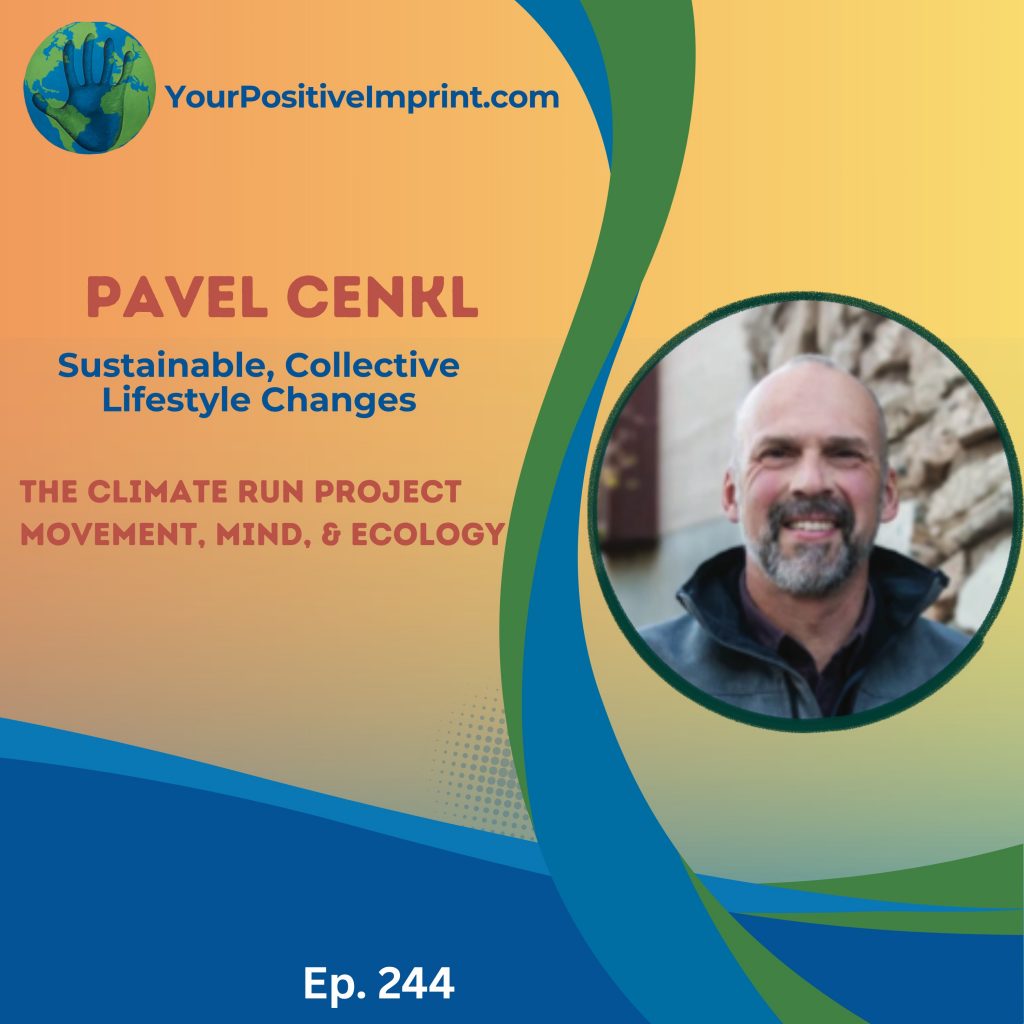
Pavel Cenkl, of Prescott University, integrates ecology, community, and experiential learning (mind) into his educational framework. He’s the founder of the Climate Run project raising awareness about climate change through movement and endurance running. He ran across Iceland! Cenkl emphasizes the importance of rebuilding relationships as a means of fostering regeneration for the planet.
Transcript
The Climate Run project was born and my first
Pavel Cenkl:project was to run across Iceland.
Pavel Cenkl:Over three days from the south coast to the north coast, and, literally being
Pavel Cenkl:in places where the melting of glaciers has caused the Earth's crust to rise.
Rick Huff:your positive, positive, positive imprint, imprint, imprint,
Rick Huff:imprint stories are everywhere.
Rick Huff:People and their positive actions inspire positive achievements.
Rick Huff:Your PI could mean the world to you.
Rick Huff:Get ready for your positive imprint.
Catherine:Hello there.
Catherine:I'm Catherine, your host of this Variety show podcast.
Catherine:Your positive imprint is transforming how we live today
Catherine:for a more sustainable tomorrow through education and information.
Catherine:Your own positive actions inspire, change.
Catherine:Follow me on Instagram and my YouTube channel, your Positive Imprint, and
Catherine:you can also follow me on Facebook and connect with me on LinkedIn.
Catherine:Check out my website, yourpositiveimprint.com, where you
Catherine:can learn more about the podcast and sign up for email updates.
Catherine:Thank you so much for listening.
Catherine:Music by the legendary and talented, Chris Nole.
Catherine:ChrisNole.com C-H-R-I-S-N-O-L-E.
Catherine:Thank you again for listening and for your support of this
Catherine:podcast, your positive imprint.
Catherine:What's your pi?
Catherine:My guest today, Pavel Cenkl, is an adventurous nature enthusiast with
Catherine:a background in English literature, particularly Native American works.
Catherine:His doctoral dissertation centered on the transformation of New England's mountains
Catherine:during the 19th century, shifting from a sparsely populated landscape to one
Catherine:heavily utilized for tourism and industry.
Catherine:Well, these significant changes serve as his core focus in his debut
Catherine:book, This Vast Book of Nature.
Catherine:Great title.
Catherine:Pavel also began the Climate Run Project, which combines endurance sports with
Catherine:climate change awareness, and he jogged across Iceland and other Arctic regions,
Catherine:witnessing climate change firsthand.
Catherine:Now, Dean of Academic Affairs at Prescott College in the United States,
Catherine:he promotes regenerative relationships within communities and ecosystems.
Catherine:Pavel advocates for a collaborative model, emphasizing the importance
Catherine:of cultivating relationships for sustainable collective lifestyle changes.
Catherine:And he is here to explain what this all means.
Catherine:Hello, Pavel.
Catherine:Welcome to the show
Pavel Cenkl:Great, Catherine.
Pavel Cenkl:Thank you so much.
Pavel Cenkl:It's a real pleasure to be here.
Pavel Cenkl:Yeah, it's always an interesting question of where you start answering that.
Pavel Cenkl:I could start in childhood with, all the trips that my parents took me on to
Pavel Cenkl:go hiking in the White Mountains of New Hampshire and, we spent months camping
Pavel Cenkl:at a time and, really engaging with the natural world, the more than human world.
Pavel Cenkl:Probably swimming when I was a little too young to be swimming in really
Pavel Cenkl:cold water and those sorts of things.
Pavel Cenkl:And I'm sure that all those experiences had their imprint.
Pavel Cenkl:We're the culmination of all of our life ex- life's experiences, aren't we?
Pavel Cenkl:Beginning in that way and how we built on that in terms of what I
Pavel Cenkl:chose to study at university and then, which was actually English literature,
Pavel Cenkl:but it ended up really looking at issues of the environment issues of
Pavel Cenkl:how land is described in literature.
Pavel Cenkl:My undergraduate thesis was on Native American literature, where
Pavel Cenkl:I spent a lot of time, reading contemporary Native American fiction
Pavel Cenkl:and historical Native American fiction and looking at the nonfiction
Pavel Cenkl:from the Southwest specifically.
Pavel Cenkl:And that actually introduced me to a whole genre of a whole field of study, a
Pavel Cenkl:whole genre of literature I hadn't known much about, and then decided to pursue
Pavel Cenkl:my master's degree in the same area.
Pavel Cenkl:And actually wrote a master's thesis on contemporary Native American novels.
Pavel Cenkl:And then I transitioned in my doctoral program to looking at probably, stemming
Pavel Cenkl:from some of those early experiences, how I, as a, as somebody who really
Pavel Cenkl:enjoyed being in the outdoors, could leverage my sort of privilege of being
Pavel Cenkl:in a PhD program and my expertise in being able to read landscapes
Pavel Cenkl:and read descriptions of landscape.
Pavel Cenkl:And I ended up writing the dissertation, which became my first book titled "This
Pavel Cenkl:Vast Book of Nature," which looked at the 19th century transformation of
Pavel Cenkl:mountains in New England from really a more sparsely inhabited mixed landscape
Pavel Cenkl:to one that was largely exploited by first the forest industry and then the
Pavel Cenkl:tourist economy from the South and, from the urban centers in New England and
Pavel Cenkl:New York and how that helped to shape that landscape in a very particular
Pavel Cenkl:way that still resonates today.
Catherine:When people pick up a book and they learn about a culture
Catherine:or a land form- … it excites them, and that spreads the word.
Catherine:That spreads positivity.
Catherine:It gets people engaged.
Catherine:Pavel, very interesting.
Catherine:And so New Hampshire, being there in the New England area and being
Catherine:in the mountains gave you the experience and the know of what it
Catherine:was like before the transformation, whether, you see it as maybe too much
Catherine:tourism, and perhaps that is true.
Catherine:And hopefully with that tourism came education for people.
Catherine:Oh.
Catherine:And that's what I always hope, is that when they visit a place, that they
Catherine:learn something to take back with them.
Catherine:Yeah.
Catherine:No, I think that's absolutely right, Catherine.
Catherine:And, it might be that shift because, those experiences are foundational.
Pavel Cenkl:When I took on the role of dean at Sterling College in Vermont
Pavel Cenkl:I ended up teaching some courses in northern circumpolar studies looking at
Pavel Cenkl:commonalities and intersections among the indigenous communities in the north,
Pavel Cenkl:as well as the landscapes of the Arctic which then had you, you mentioned my
Pavel Cenkl:Climate Run project a little bit earlier, and, that's what helped to get me into, I
Pavel Cenkl:wanna go back to those places or I wanna go experience those places firsthand.
Pavel Cenkl:Again it's really all building up this foundation of, I've had
Pavel Cenkl:these experiences in the mountains.
Pavel Cenkl:I've, published this book.
Pavel Cenkl:What can I actually do that might be helpful and generative?
Pavel Cenkl:And, using that foundation to help ideally, make some substantive change,
Pavel Cenkl:whether it's, with students at the university level or with society at large.
Catherine:Oh, awesome.
Catherine:Circumpolar?
Pavel Cenkl:Most of that has actually been in Arctic Scandinavia and,
Pavel Cenkl:north in Svalbard, where I spent a little bit of time as well, right?
Pavel Cenkl:this project probably around:Pavel Cenkl:these opportunities I had as an an endurance athlete at the time, so running
Pavel Cenkl:over long distances really slowly, mind you, but running over long distances
Pavel Cenkl:very slowly in places where, you see evidence of the impact of climate change.
Pavel Cenkl:And thus the Climate Run project was born and my first project
Pavel Cenkl:there
Pavel Cenkl:was to run across Iceland.
Pavel Cenkl:I think it was:Pavel Cenkl:I did that
Pavel Cenkl:over three days from the south coast to the north coast, and, literally being
Pavel Cenkl:in places where the melting of glaciers has caused the Earth's crust to rise.
Pavel Cenkl:There was a study in:Pavel Cenkl:you know, isostatic or post-glacial rebound to anthropogenic climate
Pavel Cenkl:change, specifically in Iceland.
Pavel Cenkl:If you're patient enough, you could sit there and watch the Earth's crust rise.
Pavel Cenkl:It was, up to about 40 milli- millimeters per year at the time.
Pavel Cenkl:So I felt like I wanted to be in a place where the impact that I was having on the
Pavel Cenkl:world and that, many folks are having, had a very explicit and measurable impact.
Pavel Cenkl:And, I played with this idea of rebounding as, as a runner
Pavel Cenkl:rebounds across the landscape.
Pavel Cenkl:So then, are you meeting the landscape in dialogue through your embodied practice?
Pavel Cenkl:And so that led to other runs across Arctic Sweden and Norway
Pavel Cenkl:trips up to Svalbard and the Faroe Islands and elsewhere.
Pavel Cenkl:I'm really drawn to those types of northern landscapes.
Pavel Cenkl:And, actually ended up teaching some classes field courses both in Iceland
Pavel Cenkl:and in in Arctic Norway working a bit with the Sami in Norway and Sweden
Pavel Cenkl:when we were there with students, and really seeing the impact not just on
Pavel Cenkl:the, glacial and periglacial landscapes, but on the flora, the fauna, and on the
Pavel Cenkl:the Sami cultural practices as well.
Pavel Cenkl:So it all started to weave together and at that same time, in academic
Pavel Cenkl:leadership, I was trying to think, "How can I leverage these experiences?"
Pavel Cenkl:which led me to teaching a lot more courses in applications of environmental
Pavel Cenkl:philosophy and how we might actually, apply what it is that we're doing in an
Pavel Cenkl:experiential and practice-led framework.
Pavel Cenkl:To think about how Prescott College, where I'm the dean of academic affairs.
Pavel Cenkl:How can we integrate ecology, community, and practice-led experience
Pavel Cenkl:into a coherent educational model.
Pavel Cenkl:I'm really concerned and interested and engaged in environmental issues
Pavel Cenkl:and recognizing that climate change a significant issue, when I started
Pavel Cenkl:king about this in the, early:Pavel Cenkl:it's only been, greatly exacerbated as we've moved forward, right?
Pavel Cenkl:I th-- and going into Iceland, the first run that I did, it's this is gonna
Pavel Cenkl:be about, let's try to change the way that athletes engage with their sports
Pavel Cenkl:and maybe we can minimize the carbon footprint of manufacturing of footwear
Pavel Cenkl:or dir- or different types of things.
Pavel Cenkl:And it very quickly came to me that's not really what it was about for me.
Pavel Cenkl:That it really was about, and this is through the personal embodied
Pavel Cenkl:experience, that how can we change our relationship with place?
Pavel Cenkl:And by doing that can we actually help shift our relationship with the data?
Pavel Cenkl:Going back and saying, "Look, the impact that we're having here in Ohio
Pavel Cenkl:or in England or wherever it might be is having this impact on glaciers
Pavel Cenkl:melting in the Arctic." how are we complicit in, in that process?
Pavel Cenkl:What changes can we make?
Pavel Cenkl:What relational changes can we make between ourselves and the more-than-human
Pavel Cenkl:world that then might shift our our buying habits or might shift our, how we how
Pavel Cenkl:we vote, how we talk to our neighbors, how we, make substantive change, right?
Pavel Cenkl:When I was working in England at Schumacher College, developed a
Pavel Cenkl:master's program about exactly this.
Pavel Cenkl:So just having come off of some of those Arctic experiences and, COVID
Pavel Cenkl:hit in early:Pavel Cenkl:down and work remotely, which was ironic having moved just to England
Pavel Cenkl:to work there than working remotely.
Pavel Cenkl:But during that period, I thought how can we still do the same thing?"
Pavel Cenkl:For a while when I was living there, we had one hour that we were allowed to
Pavel Cenkl:go outside for exercise during the day when everybody was sequestered, right?
Pavel Cenkl:And I thought, "All right. You can't get very far in an hour. So what relationship
Pavel Cenkl:can you build with the natural world, like in the field behind your house or
Pavel Cenkl:the hedgerow behind-- next to the lane or the tree that's in your backyard?"
Pavel Cenkl:And so I developed a master's program called Movement, Mind, and Ecology which
Pavel Cenkl:became quite popular over the next few years, which w- really leveraged how can
Pavel Cenkl:we bring together ecological thinking, systems thinking environmental philosophy.
Pavel Cenkl:So what have people written about these places?
Pavel Cenkl:And then movement practice, embodied practice in place.
Pavel Cenkl:And a - a pretty big component of that master's was to get the students to
Pavel Cenkl:develop and deliver community-based practice in their home communities and
Pavel Cenkl:say, "Oh, we're gonna have people do yoga in, in this field," or, "We're
Pavel Cenkl:gonna have people go on a hike.
Pavel Cenkl:We're gonna have people do this thing." a- again, in an effort to multiply
Pavel Cenkl:the impact that we could then, try to have sort of fundamental change about
Pavel Cenkl:people's relationship to the environment.
Catherine:I'd like to see more people write about their experiences,
Catherine:because then we know what was it that was their connection?
Catherine:Was it the sky?
Catherine:The ground?
Catherine:The sounds?
Catherine:No structures around or the rain?
Catherine:-- Or the animals.
Catherine:In understanding what people, what kind of connection they have and what they
Catherine:want to bring back to educate others.
Catherine:, so you talk about resilience.
Catherine:So resilience is many things, right?
Catherine:That's what you say.
Catherine:It's often described as a way to adapt a changing environment-
Catherine:… Pavel Cenkl: Yeah, I think resilience is a key component.
Catherine:I describe it as regenerative learning which is another sort of site and
Catherine:organization that, that I work on.
Catherine:What makes learning and the learning cycle and engagement
Catherine:with with different disciplines or cross-disciplines regenerative.
Catherine:And, right on the whiteboard in my office here I've got an adaptive cycle diagram.
Catherine:Your listeners might be familiar with it.
Catherine:It looks a little bit like an infinity circle or an infinity loop.
Catherine:And it's been used to describe, how ecosystems change over time and to
Catherine:recognize that it's not always growth and demise but it is always a cycle of, coming
Catherine:to a moment of flourishing and then, collapsing in a way or re-grounding and
Catherine:giving it an opportunity to rebuild and re-envision and then grow together, right?
Catherine:So it's always this sort of cons-constant adaptive cycle.
Catherine:And there's a visual concept for panarchy where you actually nest a lot
Catherine:of these adaptive cycles together, so you describe how complex an ecosystem is
Catherine:that's always undergoing these sort of perpetual changes of sort of growth and
Catherine:collapse and rebirth and growth and so on.
Catherine:And so I use that to actually model how we develop curriculum and how we
Catherine:think as an institution as well, right?
Catherine:Because right now we're-- education is under, under threat.
Catherine:It's a really challenging time.
Catherine:Even before the current administration of the US came into power there was an
Catherine:epidemic of small progressive college and university closures, both in the
Catherine:US, the UK, and elsewhere because it's a fairly inhospitable environment for a
Catherine:small private progressive institution just because of en- economies of scale costs
Catherine:and accessibility assorted with associated with higher education and so on.
Catherine:And so one of the reasons that I came to Prescott, is that I felt, that it's
Catherine:really at the intersection of ecology, community, and action we can insert
Catherine:ourselves into this leverage point in the system and say, "All right, through
Catherine:practice-led learning, through firsthand experience with place in relation
Catherine:with sort of ecological systems," so understanding how we as humans work within
Catherine:the more-than-human world to make…
Catherine:Not just minimize our impact, not just make things sustainable
Catherine:for the future, but to actively regenerate our relationship
Catherine:with the more-than-human world.
Catherine:from its roots in sort of the:Catherine:agroecology and agriculture where they were talking about rebuilding soil.
Catherine:And if you don't have soil health, you don't have anything, right?
Catherine:So if we're constantly thinking about, even in education, our programming,
Catherine:how do you rebuild the students' relationship with the place or with
Catherine:the more-than-human world or with the communities that they're engaging with in
Catherine:an active way to make that relationship more robust, more resilient, and better
Catherine:then we're starting to get somewhere.
Catherine:It's about rebuilding that relationship.
Catherine:The reason that I do the work that I do is I think it's through that
Catherine:embodied active practice of learning that you can do that the best.
Catherine:And you can actually bridge some really interesting divides through
Catherine:that physical activity, whether it's planting trees whether it's, growing
Catherine:food and give some of that surplus food to students for free to use in their
Catherine:kitchens or, engaging in different types of practices in the community, that
Catherine:it's through that firsthand practice and experience, which is I think a
Catherine:lot of higher education has shifted away from that and isolated itself.
Catherine:And I think what we're trying to do is to rebuild those community connections.
Catherine:And that experience will enhance your learning.
Catherine:Both here and when I was at Schumacher College in England,
Catherine:it was very much practice-led.
Catherine:The first thing that they did was go out and observe birds and bird behavior
Catherine:in their environment and, think about it, look at it, enact it in some ways.
Catherine:Like, how can you be in that landscape with the birds in that environment?
Catherine:And then take what they saw and what they experienced and
Catherine:bring it back to the classrooms.
Catherine:Like, all right, now we're gonna talk about economics.
Catherine:And how does what you saw in relationship with the birds and the trees and the
Catherine:wind and the rain, how can we apply that to this sort of systems thinking?
Catherine:Which is what it is, right?
Catherine:It's a, embodied practice as a way to open the door to systems thinking.
Catherine:What have you seen as the end result?
Pavel Cenkl:And I think the end results are as varied as a- as the
Pavel Cenkl:interests of the students come in with.
Pavel Cenkl:Yeah.
Pavel Cenkl:Yeah.
Pavel Cenkl:I put together a list of about 30 or 35 local businesses that are
Pavel Cenkl:run by Prescott alumni or have been founded by Prescott alumni.
Pavel Cenkl:, on that list are a number of experientially based schools that
Pavel Cenkl:are here in, in the city of Prescott.
Pavel Cenkl:So I think we have a lot of educators that come out of here.
Pavel Cenkl:We have a lot of people who are interested in one, how to engage the
Pavel Cenkl:community, how to make the community more vibrant and better, whether
Pavel Cenkl:that's through theater or music or any number of different industries.
Pavel Cenkl:We have folks who are engaged in embodied practice.
Pavel Cenkl:We have yoga practitioners.
Pavel Cenkl:We have people that run guide services.
Pavel Cenkl:We really run the full spectrum and I think it's because of that sort
Pavel Cenkl:of engagement that sense of sort of relationality and wanting to
Pavel Cenkl:engage and wanting to think about how they work within an ecosystem,
Pavel Cenkl:how they work with communities.
Pavel Cenkl:We've had two global field campuses at Prescott, one in Kino Bay in Mexico
Pavel Cenkl:and one in Kenya in Maasai land, so just north of the Maasai Mara in Kenya.
Pavel Cenkl:And I've, I've been to both of these over the last year.
Pavel Cenkl:And, those two, I actually went to a PhD student retreat, so we have PhD
Pavel Cenkl:program in sustainability education and we brought a number of those
Pavel Cenkl:students down to the Kino Bay Center.
Pavel Cenkl:Thought about and recognized how that center works with the local
Pavel Cenkl:community, with the indigenous community- … With arts, with
Pavel Cenkl:research, with science, with marine ecosystems, all in this amazing place.
Pavel Cenkl:How can you try to replicate that idea of experience at the intersection
Pavel Cenkl:of these different things, of cultures, of ecologies, of practice
Pavel Cenkl:and go and apply that to whatever you happen to be doing, right?
Pavel Cenkl:We've recently become members of the Planetary Health Alliance, for instance.
Pavel Cenkl:And that's a great umbrella organization that actually stitches together
Pavel Cenkl:public health and ecological health and how the two are inextricably and
Pavel Cenkl:holistically related to one another.
Pavel Cenkl:It's all interconnected in such a way you can't just think about, "Oh, I'm gonna
Pavel Cenkl:study counseling over here," but not think about the environment or vice versa.
Catherine:And that, by the way, I didn't give the website for that.
Catherine:That's regenlearning.org, and that's R-E-G-E-N-L-E-A-R-N-I-N-G.org.
Pavel Cenkl:When we look at the future of higher education, as I mentioned, it's
Pavel Cenkl:in crisis and it's in peril both because, of what's going on in the government
Pavel Cenkl:today as well as I think just broadly, higher education needs to find its way.
Pavel Cenkl:And I think there's, opportunity for a pretty seismic shift in what
Pavel Cenkl:universities and colleges are able to do with and for in collaboration
Pavel Cenkl:with communities and with the ecosystems that they're part of, right?
Pavel Cenkl:And part of that is recognizing we, as I do here, we can't do everything.
Pavel Cenkl:We can't be, a university for everybody for all disciplines, right?
Pavel Cenkl:So I think there's a lot to be said about collaboration, about networking about
Pavel Cenkl:what I describe as a distributed model of learning where, you're able to provide
Pavel Cenkl:a strength in one area, but you partner with others who are able to provide
Pavel Cenkl:strengths in others, and suddenly you have a really strong network of institutions
Pavel Cenkl:that serve, I think a much stronger and I think, I would say better purpose than a
Pavel Cenkl:single monolithic institution ever could
Catherine:those are words of wisdom.
Catherine:They truly are.
Catherine:And I hope, and you said a seismic change- Yeah … and I think that it does leave
Catherine:us open to move in a way that we never have before, so I look forward to that.
Catherine:And I hope everything works out.
Catherine:Yeah.
Catherine:So Pavel, your last inspiring words.
Catherine:Hmm.
Pavel Cenkl:I think, a lot of it is summing up what we've discussed here,
Pavel Cenkl:Catherine, and that's it-- when you boil it down to it, it's really about
Pavel Cenkl:building relationships and cultivating those relationships, and whether that's
Pavel Cenkl:with the, the communities the neighbors right next door community businesses
Pavel Cenkl:and also the ecosystems around you.
Pavel Cenkl:Often thinking about how do I cultivate that relationship in a
Pavel Cenkl:way that will be regenerative will help make the environment better
Pavel Cenkl:for the next generation, will help build community relationships
Pavel Cenkl:that are resilient and that last.
Pavel Cenkl:And in fact, it needs to be regenerative for yourself as well.
Pavel Cenkl:So I think building those strong relationships can actually be
Pavel Cenkl:regenerating for the individual.
Pavel Cenkl:And so I try to do that, try to cultivate that, and try to integrate
Pavel Cenkl:that into the curriculum here.
Pavel Cenkl:Excellent.
Pavel Cenkl:Pavel Cenkl,
Catherine:I love ecology, community, action.
Pavel Cenkl:Thank you, Catherine.
Catherine:Great.
Catherine:Oh, you're welcome.
Catherine:Thank you for being here on "Your Positive Imprint." Oh, it's been my pleasure.
Catherine:Go to climaterun.org or regenlearning.org.
Catherine:If you'd like to buy me a coffee to help fund the production
Catherine:of this podcast, here's how.
Catherine:Go to buymeacoffee.com/Yourpositiveimprint and any support you offer
Catherine:will be greatly valued.
Catherine:Thank you so much for your support and for listening to your positive imprint.
Catherine:And until next time, your positive imprint.
Catherine:What's your P.I.?